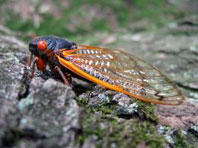
The Cicadas are here! Loud and proud! Now what? How does our industry respond? Colleagues in various other regions have shared with me that their broods arrived 2 and 3 years ago. One reader in Colorado, Jackie Burghardt, emailed a photo of one of their "dog day" cicadas. See the green beauty below left. Ours look a lot different, black with red eyes (right).I'm no expert, but I really think these guys are cool. They grow underground for 17 years and emerge nearly simultaneously. Then they do it again. Very cool.
That said, the sound they make is overwhelming in some areas. Carrying on a conversation is impossible. They wake us up in the morning. You can hear them on through closed car windows on the highway.
As for our industry, the press and knowledgeable sources are not helping. Most recommend that people not plant for the 3, 4 or 5 weeks that these critters are around. Yeah, right. See for yourself:
Chicago Botanic Garden
University of Illinois
See these sites recommended by subscriber Jackie Burghardt:
http://www.ext.colostate.edu/Pubs/insect/05590.html
http://ohioline.osu.edu/hyg-fact/2000/2137.html
I did a quick, informal poll of landscape contractors in the Chicago area. Here are a few comments:
At Schmechtig Landscapes the policy is "business as usual." A pre-cicada letter was sent to all clients to preempt any concerns. So far, there are no problems to report.
We are going ahead business as usual. We are telling everyone not to worry. Our warranty is a relationship thing. We feel that when clients place there trust in us, we have to live up to that. Every situation is different, but as long as we do the right thing everyone wins. It's all about the relationship. Personally, I think this is exciting because it brings more attention to what we do in the green industry. And for whatever reason, I've always been intrigued by large "bugs" like praying mantis, cicadas, etc as they have human-like qualities that we can relate to.
Jeff
Jeff Korhan, CLP, ASLA
Treemendous Landscape Company®
www.treemendous.com
blog: www.enhanceyourenvironment.com
Tim, Yeah, sure.Technically my replacement policy covers only dead plants. Plants damaged for various reasons (except during the planting process) are not covered. But you and I know that our clients never read the guarantee or if they do they choose to ignore it, so we'll replace the plant anyway. Most of my clients fortunately are patient and will wait to see if a plant will recover. Ive replaced plants too soon in the past. My back yard is full of them!
Damage may be anything from a couple twig ends drying up to some scarring of some of the main trunks of a multistem which sometimes resembles hail damage after a few seasons. I don't remember seeing a whole plant dying because of it.
Glenn Szmurlo, The Green Side (773-631-3696)
Hi Tim,
Many of our clients live in areas where the 17 year nasty has not yet made an appearance (new development or areas where the insect has not migrated to), so for those clients our usual warranties apply. For affected areas, we have given the client the choice (and responsibility) to select their installation date. As we do not anticipate the cicadas causing a mortality issue for new plantings, the typical twig damage would need to be pruned or netting could be installed as a preventative. As usual the news media has made this into a mega issue. Seems to me we should celebrate this wonder of creation or just break out the chocolate sauce and enjoy a snack!
Best,
Bob
Robert S. Hursthouse, ASLA Hursthouse, Inc
Also "business as usual" are Milieu Design, Inc., Anderson Landscapes and Greenhaven Landscapes So, basically, despite press reports of doom and gloom, the landscape world forges on! Anyone with anything else to offer, please speak up!
Tuesday, June 12, 2007
Wednesday, May 30, 2007
Oklahoma Gardening
Okay, this is an old one. In 2004 I was the keynote speaker at Gardenfest, a summer garden festival run by Steve Owens, host of Oklahoma Gardening. Steve and his crew came to Glenview to do a pre-festival episode of O.G. with me. Here is the show that aired a week before Gardenfest 2004.
For more info on Gardenfest, see here.
Google video makes this much easier than it use to be.
For more info on Gardenfest, see here.
Google video makes this much easier than it use to be.
Monday, May 28, 2007
More Cicadas!
The Cicadas are here!
A colleague told me he was on a property in Winnetka (a nearby suburb for those not in the Chicago area), and, using his words, "It looked like the ground was moving!"
Our brood (Brood XIII), is supposed to be the biggest in the U.S. There is a lot of anxiety about them, but I'm excited. In response to my last e-newsletter (sign up here), several folks in the Mid-Atlantic told me their brood(s) arrived 2 or 3 years ago. Same in Indiana. All I can tell you is that ours is arriving as I type!
My friend Pam Duthie sent me a link to the the following video which tells how these fascinating critters work. Really cool.
A colleague told me he was on a property in Winnetka (a nearby suburb for those not in the Chicago area), and, using his words, "It looked like the ground was moving!"
Our brood (Brood XIII), is supposed to be the biggest in the U.S. There is a lot of anxiety about them, but I'm excited. In response to my last e-newsletter (sign up here), several folks in the Mid-Atlantic told me their brood(s) arrived 2 or 3 years ago. Same in Indiana. All I can tell you is that ours is arriving as I type!
My friend Pam Duthie sent me a link to the the following video which tells how these fascinating critters work. Really cool.
HGTV's Landscapers' Challenge follow up
This show aired in May, 2007 and features me, Tim Thoelecke, as well as two friends and local designers, Todd Hayden from Schmechtig Landscapes and Nancy Sauerberg from Nancy Sauerberg Design. Learn more about Landscapers' Challenge here. This episode is scheduled to air again on July 8, 2007.
Some key thoughts:
Notice that all three designs had a lot in common.
The $75k budget at first seemed like plenty, but in reality, it was about half what was needed. The owners got a significant "deal" on this project.
Did Nancy get cheated in the camera time department?
Notice how I start w/ a necktie, but it's gone by the end? The crew determined that the tiny Chicago Cubs logo on it was not permitted.
Anyway, for anyone who missed it, click below. I'd be interested in any comments or questions, which you can post by clicking below.
Some key thoughts:
Notice that all three designs had a lot in common.
The $75k budget at first seemed like plenty, but in reality, it was about half what was needed. The owners got a significant "deal" on this project.
Did Nancy get cheated in the camera time department?
Notice how I start w/ a necktie, but it's gone by the end? The crew determined that the tiny Chicago Cubs logo on it was not permitted.
Anyway, for anyone who missed it, click below. I'd be interested in any comments or questions, which you can post by clicking below.
Friday, May 25, 2007
What's in a name?
At a social function recently, I ran into a friend who also is a former
client. In the course of small talk, she asks, "So how's the gardening business?"
I politely responded and continued our conversation, though inside I was seething. We did a fairly large project for this woman, including a pretty substantial stone patio and a pretty cool water feature. Yes, there were plants too, and plenty of them. Furthermore, I know she is active in her garden club. One would THINK she would know that there is a difference between what I do and what "gardening" is.
Am I a gardener? Sure. But that's at home. My chosen career is landscape design.
What are you? Do you deliberately choose what vocabulary to you use when discussing your profession. If you don't, you ought to.
Are you a landscaper? Gardener? Landscape architect? Landscape designer? Landscape contractor? If you are a professional, you ought to use words that sound professional. It's all part of your image.
Put yourself in the shoes of someone not in our industry. What image does the term "landscaper" conjure up? Perhaps that is the image you want. For me, no.
What I do is equal parts art and science. In order to do what I do, and do it well, I need to understand bits and pieces of many other professions. Among those professions, I count civil engineer, architect, horticulturist, environmentalist, carpenter/woodworker, ironsmith, mason, plumber, electrician, and more. How many of those are "gardening"? One. Is gardening an important element? Certainly. But I'm not in the gardening business.
How do we communicate these things to someone not in the industry? I don't know. It's hard enough to communicate them to people IN the industry!
More on this topic later. The cicadas are coming.
At a social function recently, I ran into a friend who also is a former
I politely responded and continued our conversation, though inside I was seething. We did a fairly large project for this woman, including a pretty substantial stone patio and a pretty cool water feature. Yes, there were plants too, and plenty of them. Furthermore, I know she is active in her garden club. One would THINK she would know that there is a difference between what I do and what "gardening" is.
Am I a gardener? Sure. But that's at home. My chosen career is landscape design.
What are you? Do you deliberately choose what vocabulary to you use when discussing your profession. If you don't, you ought to.
Are you a landscaper? Gardener? Landscape architect? Landscape designer? Landscape contractor? If you are a professional, you ought to use words that sound professional. It's all part of your image.
What I do is equal parts art and science. In order to do what I do, and do it well, I need to understand bits and pieces of many other professions. Among those professions, I count civil engineer, architect, horticulturist, environmentalist, carpenter/woodworker, ironsmith, mason, plumber, electrician, and more. How many of those are "gardening"? One. Is gardening an important element? Certainly. But I'm not in the gardening business.
How do we communicate these things to someone not in the industry? I don't know. It's hard enough to communicate them to people IN the industry!
More on this topic later. The cicadas are coming.
Subscribe to:
Posts (Atom)
